 Cool start
Late April and May
Start of the season
- Wet days
- 14, then 11
- Daylight
- 14.1 to 16.1 hrs
- Highs
- 10.9 to 15 °C
Guides
Language
EnglishCurrency
US dollar · $GetYourGuide converts to the currency you select here.
Guide · Best time
The Misty Fjords aerial view changes with every sky. Here is how wet Ketchikan really is in each month of the flying season, how long the days are, and what that means for the view.
Editorial team, mistyfjordsflightseeing.comUpdated October 25, 2026Reading time about 6 minutes5 sources
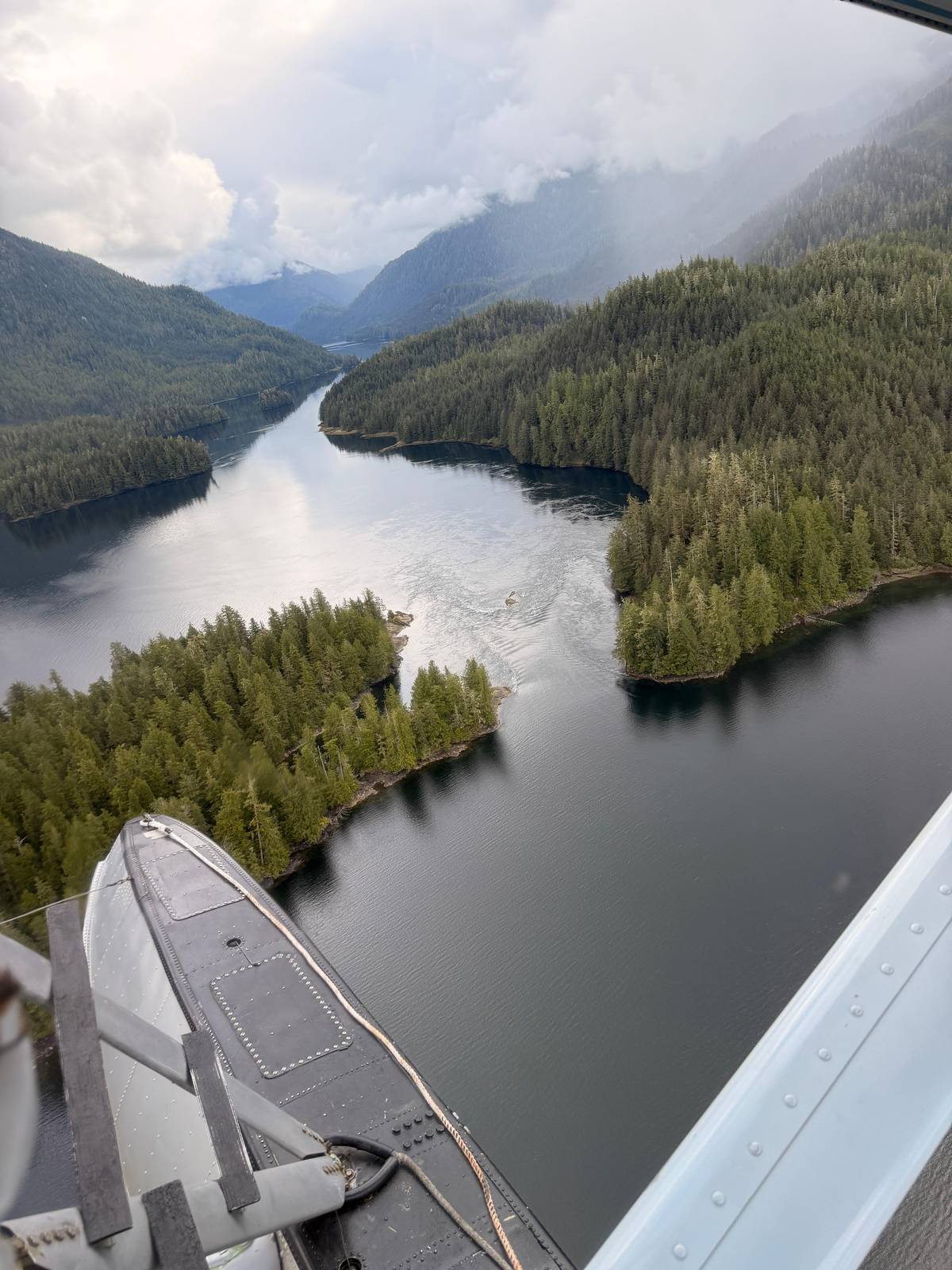
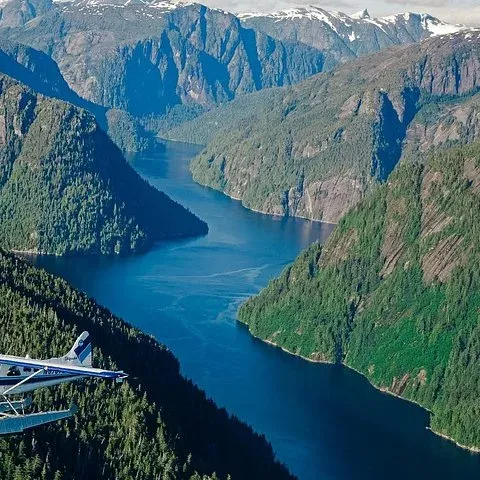
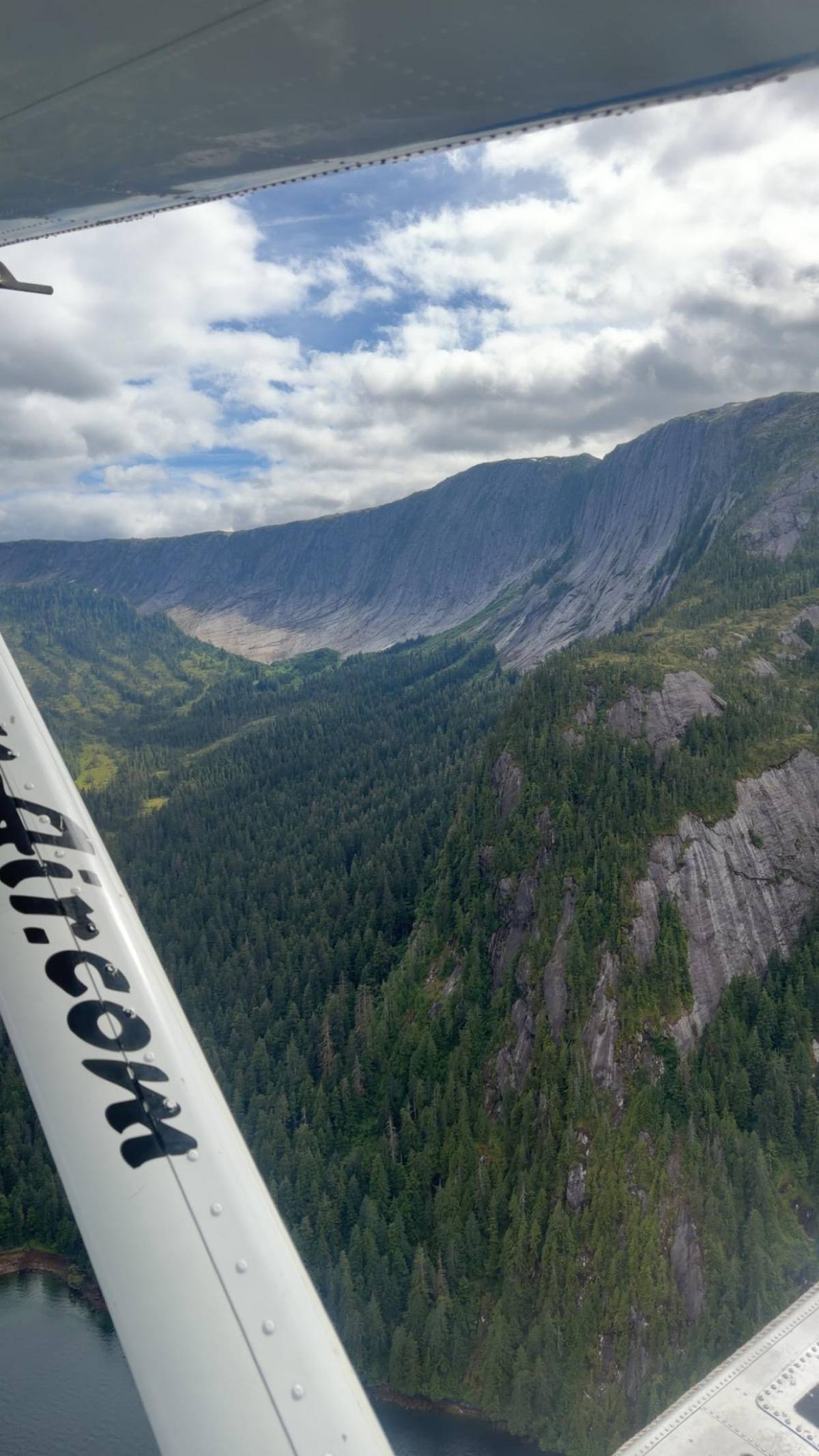
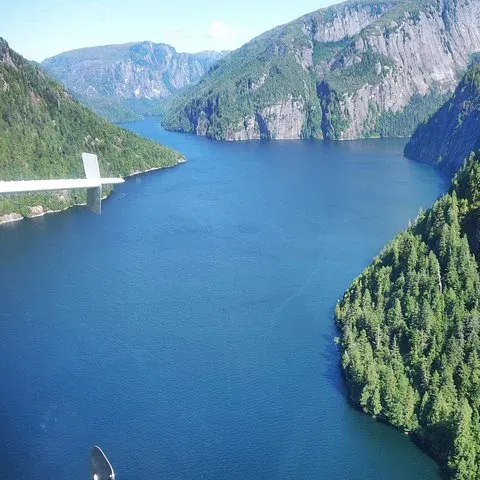
The Misty Fjords aerial view is a landscape of steep walls and water. About 17,000 years ago ice covered the area, and as it withdrew it carved long, deep fiords with cliffs that rise for thousands of feet.2 From a floatplane you look down into those fiords, across ridges and onto lakes that sit in hanging valleys above the bays.
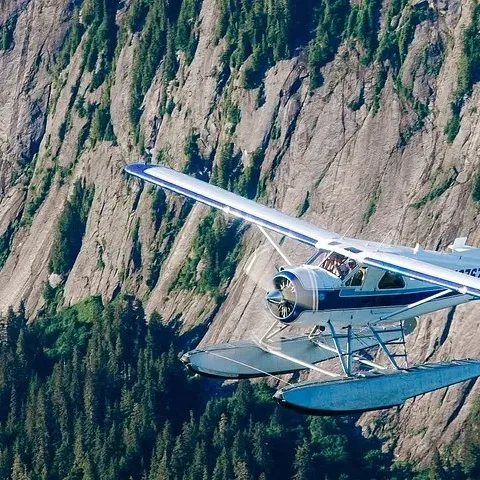
The flight this site features passes over the Tongass rainforest, granite walls and waterfalls, Rudyerd Bay and the volcanic spire of New Eddystone Rock, and every guest has a window seat. From the air the colors are the story: dark green forest, gray granite, black water and the white threads of falling water on the walls.
What you see on the day depends on the sky more than on anything else. On a clear day the view reaches far east toward the border mountains; under low cloud the walls disappear into gray, and the plane may stay lower or not fly at all. The rest of this page is about those odds, month by month.
The season
April 25
First scheduled flights of the 2027 season.
May
11 wet days and 171 mm of precipitation on average.1
June
17.4 hours of daylight at mid-month, and the least rain.1
August
270 mm of precipitation and 13 wet days.1
September
484 mm of precipitation and 18 wet days.1
October 22
Last scheduled flights; October averages 541 mm.1
Ketchikan is wet in every month, and the numbers are worth seeing before you book. NOAA's Beaver Falls station records 240 mm of precipitation in April, 171 mm in May and 150 mm in June, the lowest monthly figure of the year.1 Even that driest month has 11 days with 2.5 mm or more.1
The second half of the season is wetter. July brings 172 mm, August 270 mm, September 484 mm and October 541 mm, with 20 days of 2.5 mm or more in October.1 On those figures, a September or October flight is far more likely to meet rain or cloud than a flight in May or June.
Rain does not always mean no flight, and a grey sky can still give a dramatic view. But wet weather is also behind most of the low reviews of this site's flight: in the newest 100 reviews, 11 of the 13 one-star ratings are about a cancelled flight, most of them for weather. Treat every booking as weather permitting.
Climate
Month by month
| Month | Daylight (h) | Darkness (h) | High / low | Wet days | Floatplane traffic |
|---|---|---|---|---|---|
| Jan | 7.7 | 16.3 | 4 / 0 °C | 18 | |
| Feb | 9.6 | 14.4 | 6 / 1 °C | 14 | |
| Mar | 11.7 | 12.3 | 7 / 1 °C | 17 | |
| Apr | 14.1 | 9.9 | 11 / 3 °C | 14 | |
| May | 16.1 | 7.9 | 15 / 6 °C | 11 | busy skies |
| Jun | 17.4 | 6.6 | 18 / 9 °C | 11 | busy skies |
| Jul | 16.9 | 7.1 | 19 / 12 °C | 12 | busy skies |
| Aug | 15.1 | 8.9 | 19 / 12 °C | 13 | busy skies |
| Sep | 12.8 | 11.2 | 15 / 9 °C | 18 | |
| Oct | 10.6 | 13.4 | 11 / 6 °C | 20 | |
| Nov | 8.4 | 15.6 | 6 / 2 °C | 20 | |
| Dec | 7.2 | 16.8 | 4 / 0 °C | 19 |
What each column holds for Ketchikan: light hours in mid-month, the warmest and coldest point of an ordinary day, and how often 2.5 mm of rain fell, per NOAA over 1991 to 2020.1 Season according to the US Forest Service.3
Three seasons
Cool startStart of the season
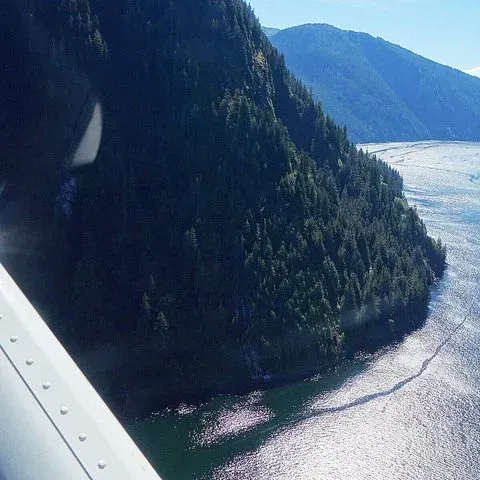 Best odds
High summer
 Wettest
End of the season
Decision helper
Match your priority to the season
June has the least precipitation, 150 mm, and 11 wet days.1
Average daily highs are 18.7 °C in July and 18.9 °C in August.1
Plane traffic is heaviest from May through August.3
Rain feeds the falls; fly when the cloud lifts.
September averages 18 wet days, so leave time for a cancellation.1
This shelter is located in the flight seeing path of floatplanes so there may be heavy daytime plane traffic from May through August.
On the numbers, the best time to see Misty Fjords from a floatplane is late May to July. May and June each average 11 wet days, the fewest of the flying season, and June has the least precipitation of any month.1 Days are long too: around the middle of May the sun stays up 16.1 hours, and in mid-June 17.4 hours.1
July and August are warmer, with average daily highs of 18.7 °C and 18.9 °C, and still fairly dry in July.1 They are also the busiest months over the fiords. A Forest Service page warns of heavy daytime plane traffic in the floatplanes' sightseeing path from May through August.3 You will rarely have the sky to yourself.
April and October are the edges of the season. The operator's 2027 schedule runs from April 25 to October 22. April is cool, with an average high of 10.9 °C, and October is the wettest month of the year, with 541 mm.1 Book the edges for quieter skies, not for the odds of a clear day.
Checklist
Video
The video plays from YouTube only after you press play.
Rain has one clear upside: it feeds the falls. After a wet night, threads of water pour down granite walls that are dry in a sunny week, and the Misty Fjords waterfalls are often at their best on the morning after a storm, if the cloud has lifted. From the air they look like white lines drawn down the rock, some falling straight into the sea.
Low cloud is the real enemy, not rain. Cloud can sit on the ridges and fill the upper fiords while the water below stays clear, and a floatplane needs to see where it is going. On those days the operator may cancel; the listing allows it to cancel for bad weather. When the cloud lifts in the afternoon, the view can be at its finest.
Mist is part of the name and part of the look. A day with low cloud drifting between the walls gives the photographs their mood, and you may well come home with pictures of half-hidden cliffs rather than blue skies. Pack for rain, hope for breaks in the cloud, and do not cancel a booking just because the forecast says showers.
The flying season sits in the long days of the northern summer. Daylight at mid-month lasts 14.1 hours in April, 17.4 hours in June and 15.1 hours in August, then shrinks to 10.6 hours in October.1 Late departures in October fly in a much shorter day, so check the time of sunset before you book an evening slot.
Temperatures are mild rather than warm. Average daily highs run from 15 °C in May to 18.9 °C in August and back to 10.9 °C in October.1 The cabin is closed, so you do not need special gear for the flight, but the dock and the walk to the plane are outside.
Low sun gives warm light for photographs, and the long evenings of June and July stretch it out. A late afternoon flight puts warm light on the eastern walls, while a midday flight lights more of the deep fiords. Choose by your ship's timetable first, then by the light, and accept that cloud may decide for you.
Look at the mountains above town before you look at your phone. If the tops of the ridges across the Tongass Narrows are clear, the view over the fiords has a good chance; if the cloud sits halfway down the slopes, expect a grey flight or a call from the operator. A forecast of showers says little on its own in a place this wet.
Keep your phone on and the booking confirmation at hand from the moment you leave the ship. Reviewers of this site's flight describe calls and messages from the operator shortly before departure when the weather turned, and those who answered early had the most time to change their plans for the day.
If the flight goes, arrive at Berth 2 15 minutes early anyway, even under a grey sky. Cloud often moves quickly over the fiords, and the walls can appear and disappear within minutes. A flight in changing weather can be more dramatic than a flight under a flat blue sky, with light breaking through onto the granite and the waterfalls.
Every guest on this site's flight has a window seat, so the main challenge is the glass, not the seat. Wipe the window patch in front of you before takeoff, turn off the flash, and hold your camera close to the glass without touching it. Wear dark clothing; a light jacket reflects in the window and spoils the picture.
Use a fast shutter, because the plane vibrates and keeps moving. Wide angles work better than a long zoom for fiords and lakes. Look for the contrast between pale granite and dark water, the line of a waterfall, and New Eddystone Rock standing alone in Behm Canal, a lava plug 237 feet tall.4
Mountain goats patrol the ridgelines and can be seen from the window of a floatplane, but they are small at flying height.5 Do not spend the whole flight hunting them through a lens. Take your photos on the way in, then lower the camera over the deepest fiords and simply look; the view is the part you came for.
Ready to fly
Pick a departure that fits your ship, then meet the van at Berth 2.
June, on the numbers. June has the least precipitation, 150 mm, and the longest days, with 17.4 hours of daylight at mid-month.1
September and October. September brings 484 mm and October 541 mm of precipitation in Ketchikan.1
Sometimes, not always. The operator can cancel for bad weather; low cloud matters more than light rain.
April 25 to October 22. That is the operator's scheduled 2027 season for this flight.
Mild, not hot. Average daily highs are 18.7 °C in July and 18.9 °C in August in Ketchikan.1
Usually, yes. Rain feeds the falls on the granite walls; a clearing morning after a wet night is ideal.
Outside May to August. A Forest Service page warns of heavy floatplane traffic from May through August.3
Sources
Keep reading